Building Sovereign AI Systems with Azure
A private model is not a sovereign system. How to use Azure, Azure Local and HVE-style engineering to build agents that operate under explicit rules for data, identity, decisions and execution.
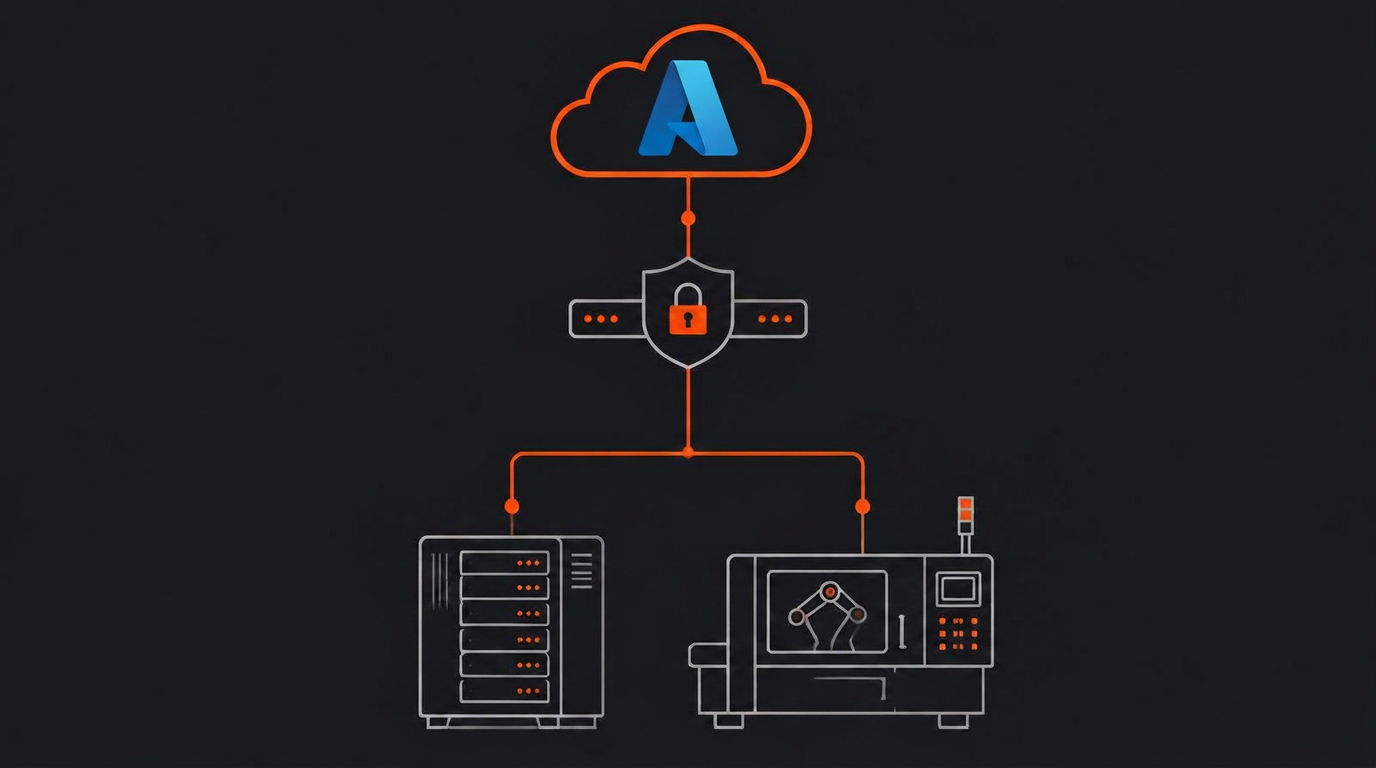
Frontier speed. Customer-controlled execution.
A private model is not a sovereign system. If its tools can reach anything, its logs leave the environment, or its fallback quietly sends sensitive work to an external service, moving inference on-premises has solved only part of the problem.
The goal should be more ambitious: use powerful AI to accelerate development, then operate the resulting system under explicit rules for data, identity, decisions, and execution. Azure provides several deployment paths for that architecture. HVE provides useful patterns for the engineering process. Neither removes the need to decide what the system may do, where it may do it, and how you will prove that it stayed within those limits.
At Enfuse, our approach is to connect those pieces: the Microsoft platform, enterprise integrations, private infrastructure, and the engineering required to turn a promising agent into an operable system.
Start with the boundary, not the model
Before selecting a model or drawing an architecture, write down the operating contract. Which information can the system read? Which people and services can access it? Where can inference, retrieval, memory, and logging happen? Which actions require approval? What must happen when a provider, network connection, or model becomes unavailable? Those decisions determine the architecture, and they should not be discovered after the agent has been connected to production systems.
For example, an organization might permit cloud-assisted development using synthetic data while requiring operational inference and customer records to remain on-site. Another might permit a managed Azure deployment within an approved geography but prohibit external web tools and cross-boundary fallback. Both are legitimate design starting points. They are not the same system.
Sovereignty is the operating contract. Infrastructure is how you enforce it.
Microsoft's sovereignty portfolio includes public, private, and national-partner approaches. Their availability and operational commitments vary by geography and service, so an ordinary Azure deployment should not automatically be described as a sovereign-cloud offering.
Choose the Azure deployment pattern that matches the requirement
A useful starting point is to distinguish three patterns. These are architectural choices, not interchangeable labels.
| Pattern | When to consider it | What must be established |
|---|---|---|
| Managed Azure AI | Policy permits managed cloud processing within an approved scope | Model hosting and processing location, identity, private networking, storage, and tool access |
| Connected Azure Local | Workloads run on customer premises while approved cloud management remains available | Local data paths, management connectivity, model availability, and operational dependencies |
| Disconnected Azure Local | The system must operate without an ongoing connection to Azure public cloud | Supported workload set, local identity and management, offline updates, and sufficient local capacity |
Microsoft documents Azure Local disconnected operations as a distinct deployment model with an on-premises control plane and offline or staged servicing. It supports a subset of capabilities, not every Azure service running unchanged in a private datacenter. For local inference, Foundry Local on Azure Local provides Kubernetes-based model deployment and serving; Microsoft's current documentation identifies it as preview, with deployment access by request. Treat that as a platform-selection consideration, not a general-availability promise.
Two details deserve particular attention in managed Azure architectures. First, a private endpoint does not automatically contain outbound traffic. Foundry Agent Service distinguishes inbound access from outbound network isolation, so a private endpoint can restrict who reaches the service while agent egress remains public unless the appropriate isolation model is configured.
Second, the resource's location is not the whole processing policy. For Foundry's serverless model deployment types, Global, Data Zone, and geography-based options have different processing scopes, and not every model supports every option. Select against the actual residency requirement rather than assuming a deployment name guarantees single-region processing.
Give the model a job, not unrestricted authority
Our recommended runtime design separates interpretation from permission. The model can propose a search, a response, or a next action. The application decides whether that request is authorized for the current user, dataset, and operation. The tool executes only after those checks pass.
The same separation should apply to retrieval. A document being relevant does not make it accessible. Filter by the caller's permissions before putting content into model context, and preserve the source behind consequential claims. In an appropriate managed Azure design, Foundry Agent Service's standard setup can store files, conversation state, and vector data in customer-managed Azure resources. That is a useful building block; application-specific authorization and approval still need their own implementation.
For local execution, keep those responsibilities inside the approved environment. Do not design an otherwise local workflow that depends on an external embedding endpoint, cloud-only identity check, or unrestricted telemetry exporter without accounting for that dependency.
A model may request an action; it should not grant itself permission to perform it.
Use HVE to make the engineering repeatable
Microsoft's Hypervelocity Engineering Core brings structure to AI-assisted development through agents, prompts, instructions, and skills. Its workflow separates research, planning, implementation, review, and follow-up. Microsoft also describes HVE as rapidly evolving and recommends treating it as a source of adaptable patterns rather than a stable production dependency. For a sovereign system, we apply that discipline this way:
Reusable skills make these methods easier to apply consistently. Keep the procedure separate from a customer's private information, deployment settings, and business rules. A research skill can require source verification without containing a customer's documents. A delivery skill can require the approved validation command without assuming every project uses the same toolchain. HVE helps build and verify the system. It is not the system's authorization layer or production runtime.
Keep the engineering environment separate from production
A frontier tool used to design an application does not have to become the production application's model provider. Use cloud-based development tools only with source code, examples, documents, and logs approved for those environments. Treat engineering data as part of the sovereignty assessment, not as an exception to it. A local terminal is not proof that model inference is local.
Claude Code, for example, has a documented Microsoft Foundry integration, and Anthropic's guidance says the selected hosting option determines whether inference runs on Azure or Anthropic infrastructure. The endpoint and billing arrangement alone are not enough to establish the processing boundary. Enfuse's HVE guide covers the engineering workflow across ChatGPT and Claude Code; it does not imply that their hosted models can be packaged into an air-gapped deployment. The production runtime needs separately selected, supported models and services that meet its own operating contract.
What this looks like in a physical operation
Consider a proposed maintenance assistant for an industrial facility. This is an illustrative architecture, not a customer case study. A local perception system identifies an equipment condition. An agent retrieves the approved maintenance procedure and relevant service history. It prepares a recommendation and, when authorized, a draft work order. An operator reviews any consequential action before the application invokes the maintenance system.
The model does not receive a general-purpose machine-control credential. Safety interlocks remain outside its authority. A generated sentence saying "the work order was created" is not accepted as proof; the application needs a confirmed result from the system that owns the work order.
Now test the failure paths. The manual is stale. The operator lacks access to one asset. The tool times out after receiving a request. The WAN is unavailable. The model asks to send the incident to a cloud service that policy does not permit. The design should produce a bounded response in each case: exclude inaccessible information, flag missing evidence, reconcile an uncertain operation before retrying, continue only supported local functions, or stop for human direction.
When cloud fallback is prohibited, unavailability is a condition to handle, not permission to export the work.
That is where sovereign AI and physical AI meet: control close to the operation, with a deliberate path for exceptions.
Test control as seriously as answer quality
We recommend evaluating two things separately: whether the workflow produces useful results, and whether it obeys its operating limits. A response can be accurate and still use an unauthorized source. A tool call can have valid arguments and still exceed the caller's permission. A model can produce valid JSON while choosing the wrong maintenance action.
Before expanding autonomy, require evidence for the cases that matter: attempted unauthorized access, prohibited outbound calls, missing dependencies, ambiguous tool outcomes, cancellation, and changes to the model or prompt. Run the tests against the deployed configuration and actual persistence path, not only a mock or an in-memory demonstration.
Keep the approval attached to the artifact that was reviewed. When a material change lands afterward, repeat the affected checks and review the change. Preserve first failures and retries rather than reporting only the most favorable run. Start with one workflow whose value and boundaries can both be measured, and expand from evidence, not from the number of agents the framework can launch.
Where Enfuse fits
Enfuse provides the application and delivery engineering between AI infrastructure and the work an organization needs to accomplish. Our services span enterprise integration, sovereign and on-premises AI, Azure and Azure Local infrastructure, physical AI, and operational handoff. For an Azure-based project, that means selecting the right deployment pattern, connecting approved data and tools, implementing the operating controls, evaluating the workflow, and preparing the team to run it.
It does not require replacing the customer's Microsoft platform with a proprietary alternative. The value is in making the chosen platform support the actual operation. Use the frontier to accelerate the build. Keep authority with the organization that owns the consequences.
Key takeaway: Building Agentic Systems with HVE
Have a sovereign AI workload to build? Talk to an Enfuse architect about an Azure, Azure Local, or customer-controlled deployment.