The Future of Enterprise AI: Distributed Agents, On-Prem LLMs, AI-Driven App Factory
How Enfuse App Factory uses DGX Spark distributed agentic AI + Lenovo ThinkSystem SR675 V3 with NVIDIA H200 GPUs to ship production AI-driven apps—fast, sovereign, and on-prem. The future of AI-native software manufacturing.
The Future of Enterprise AI: Distributed Agents, On-Prem LLMs, AI-Driven App Factory
How Enfuse App Factory uses DGX Spark + Lenovo ThinkSystem SR675 V3 with NVIDIA H200 to ship real AI-driven apps—fast, sovereign, and production-ready
Enterprises are moving past "AI-assisted coding" as a feature and into something bigger: AI-native software delivery. In this new world, the unit of productivity isn't a single developer typing faster—it's a system of agents + services + guardrails that can plan work, compose platform capabilities, generate artifacts, verify correctness, and continuously ship.
At Enfuse, we believe the winning architecture is hybrid—both distributed and centralized:
- Distributed where decisions must be made close to teams, data domains, and operational reality.
- Centralized where heavyweight code generation and verification should be pooled for quality, consistency, and governance.
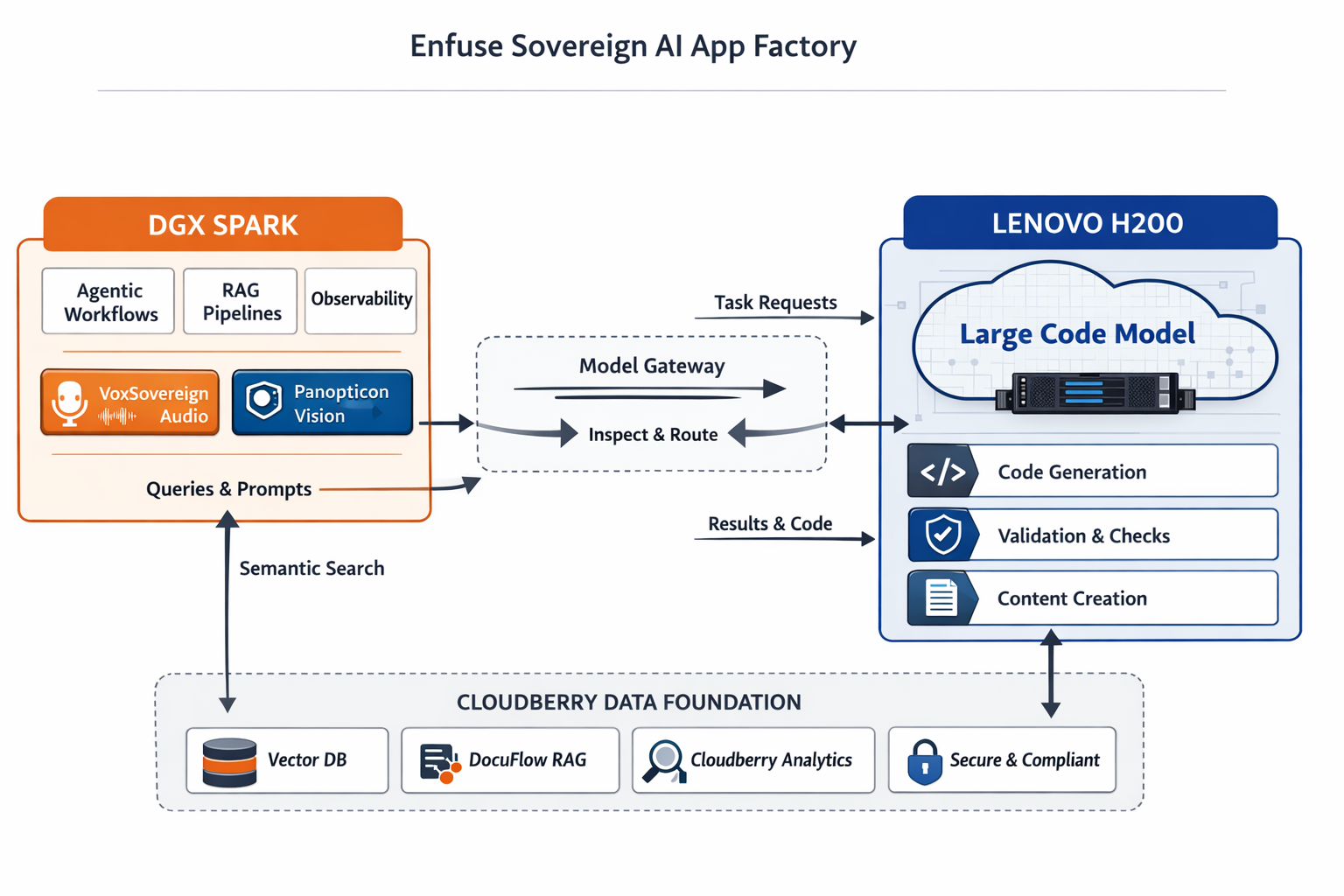
That's why our App Factory pairs DGX Spark (distributed agentic control) with Lenovo ThinkSystem SR675 V3 servers running NVIDIA H200 GPUs (centralized "very large coding model" inference)—all inside a sovereign, Kubernetes-native platform.
And to be clear: this is not about training models. This is about building production apps with services, safely and repeatably.
The big shift: from "coding" to "software manufacturing"
Traditional enterprise delivery is linear and manual: requirements → tickets → code → review → security → deployment → ops. The cycle time is dominated by handoffs, inconsistency, and risk management.
In the App Factory model, delivery becomes manufacturing:
- A request is translated into a plan (tasks, dependencies, checks).
- Services are composed (RAG, data, CI/CD, observability, security).
- Code and artifacts are generated (APIs, UI, tests, configs, pipelines).
- Verification is continuous (policy gates, evaluation harnesses, rollout controls).
- Deployment is repeatable (GitOps, audit trails, rollbacks).
The infrastructure isn't an afterthought—it's the production line.
The architectural bet: split "agent decisions" from "code generation"
Most agent stacks try to make one model do everything: decide what to do, retrieve context, write code, review it, and deploy it. That works in demos—and breaks in enterprises.
Enfuse App Factory intentionally splits responsibilities:
DGX Spark: distributed agentic decision-making and orchestration

DGX Spark is where the Sovereign Agent layer runs—the part of the system that:
- decomposes work into tasks and decides the sequence of actions
- selects and orchestrates MCP services (RAG, data, ops, compliance tools)
- enforces governance (data residency, PII rules, tool permissions)
- routes requests to the right model endpoint through a Model Gateway
- manages reliability (retries, fallbacks, tool error handling)
- drives GitOps workflows (branch/PR creation, pipeline execution, rollout logic)
This is the "brain" that coordinates the factory.
Lenovo SR675 V3 + NVIDIA H200: centralized very large coding model inference
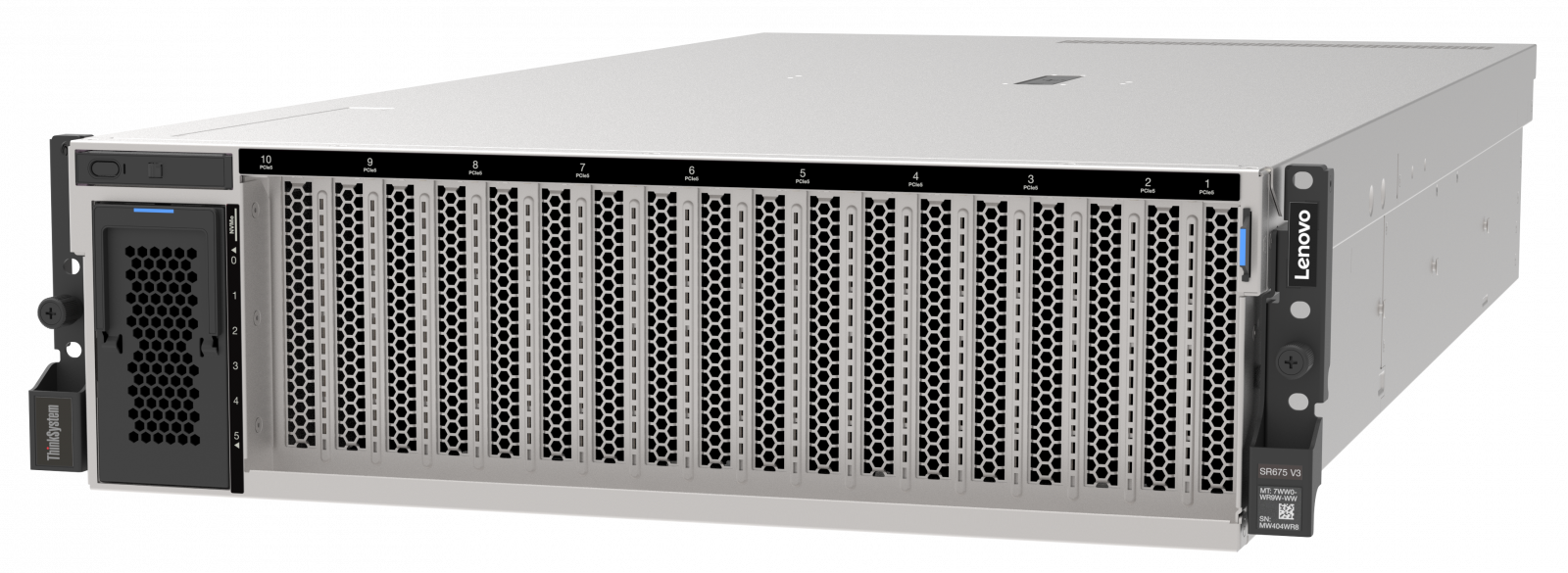
When the agent needs high-quality generation and verification at scale, it calls into the central code engine: Lenovo ThinkSystem SR675 V3 servers equipped with NVIDIA H200 GPUs.
This centralized engine is used for inference-heavy tasks like:
- code generation and refactoring across large repos
- test generation (unit/integration), CI checks, and safety assertions
- "important checks" (auth/authz correctness, sensitive data handling, policy compliance)
- producing deployable artifacts (Helm values, IaC modules, service manifests)
- generating documentation and runbooks aligned to what shipped
Lenovo's ThinkSystem SR675 V3 is built for this style of pooled acceleration: it's a GPU-rich 3U server that supports up to eight GPUs—including NVIDIA H200—and also supports HGX H200 configurations with NVLink, plus Lenovo Neptune hybrid liquid-to-air cooling options.
Why Lenovo SR675 V3 is the right "central code engine" node
In an App Factory, the centralized code engine must be:
- high-throughput (many concurrent requests from agents)
- consistent (standard behavior across teams)
- operationally predictable (managed like a platform, not a lab)
- scalable (add nodes as usage grows)
The SR675 V3 is designed as a scalable GPU platform for production AI deployments, with configurations that support larger GPU footprints and enterprise management tooling.
This matters because in the Enfuse model, the code engine is not a "developer toy." It's a shared factory resource that every team can rely on.
The partnership: Enfuse + Lenovo for enterprise-grade AI factories
This architecture becomes truly enterprise-ready when it's validated on enterprise hardware, with a clear deployment path and operational model. That's why Enfuse is partnering with Lenovo—with the ThinkSystem SR675 V3 as a key building block for the centralized inference tier.
Lenovo and NVIDIA have explicitly positioned the SR675 V3 as a centerpiece for hybrid AI solutions and production AI deployments, emphasizing GPU-rich scale and validated enterprise AI architectures.
For Enfuse customers, that translates into faster time-to-value:
- known-good reference patterns for standing up the code-engine tier
- predictable scaling characteristics as more teams adopt agentic delivery
- enterprise supportability and lifecycle management aligned to data center realities
Enfuse App Factory: services over scripts
The goal isn't to generate code in a vacuum. The goal is to ship applications built from secure, reusable services.
App Factory provides:
- MCP-native orchestration (a consistent "tool contract" for agents)
- a Model Gateway to route between local and permitted cloud models
- Sovereign MCP Services (vision/audio/RAG/data) that never leave your boundary
- Kubernetes-native delivery: templates, CI/CD, observability, policy-as-code, and GitOps
Instead of every team rebuilding pipelines, the agent composes:
- DocuFlow RAG for structured doc ingestion and retrieval
- Cloudberry-powered data foundation for governed retrieval prep and feedback loops
- GitOps Sentinel for PRs and automated delivery gates
- KubeMaster Ops for bounded, auditable operational actions
This is how "vibe coding" becomes enterprise software manufacturing.
Why hybrid distributed + centralized wins (and scales)
Distributed agents (DGX Spark) solve enterprise reality
Enterprises are inherently distributed: different regions, domains, networks, and controls. The decision layer needs proximity to:
- the right data and tools for that domain
- local policy and residency constraints
- operational context (clusters, services, environments)
Centralized code engines (Lenovo SR675 V3 + H200) solve enterprise quality
Centralizing the heavy generation tier enables:
- consistent verification standards and safety checks
- better utilization of premium GPU resources
- fewer "works on my team" forks of tooling
- a single place to harden and observe inference behavior
Hybrid is what lets you scale both velocity and governance at the same time.
What this unlocks for enterprises
With Enfuse App Factory on DGX Spark + Lenovo SR675 V3 (H200), enterprises can:
- build and ship production apps in weeks, not quarters
- keep data sovereign (including multimodal processing and retrieval)
- enforce policy automatically (not via late-stage review bottlenecks)
- standardize delivery patterns across teams without slowing innovation
- operate AI development like a factory: measurable, auditable, repeatable
This is the future of enterprise development: hybrid, distributed agentic control + centralized code generation, built on services, guarded by policy, and designed to ship.
Related Resources
What Is Sovereign AI?
Complete guide to sovereign AI platforms and data sovereignty
On-Prem LLM Deployment
Hardware requirements, deployment patterns, and implementation methodology
Sovereign Compute
GPU infrastructure management for on-premises AI workloads
Private GenAI Infrastructure
Deploy governed generative AI on your own infrastructure