Services Have Changed: From Staff Augmentation to Mission-Ready Pods
The services industry has fundamentally shifted. Today's buyers demand faster prototyping, shorter paths to production, and teams that own outcomes—not tasks. The pod model is the new atomic unit of enterprise delivery.
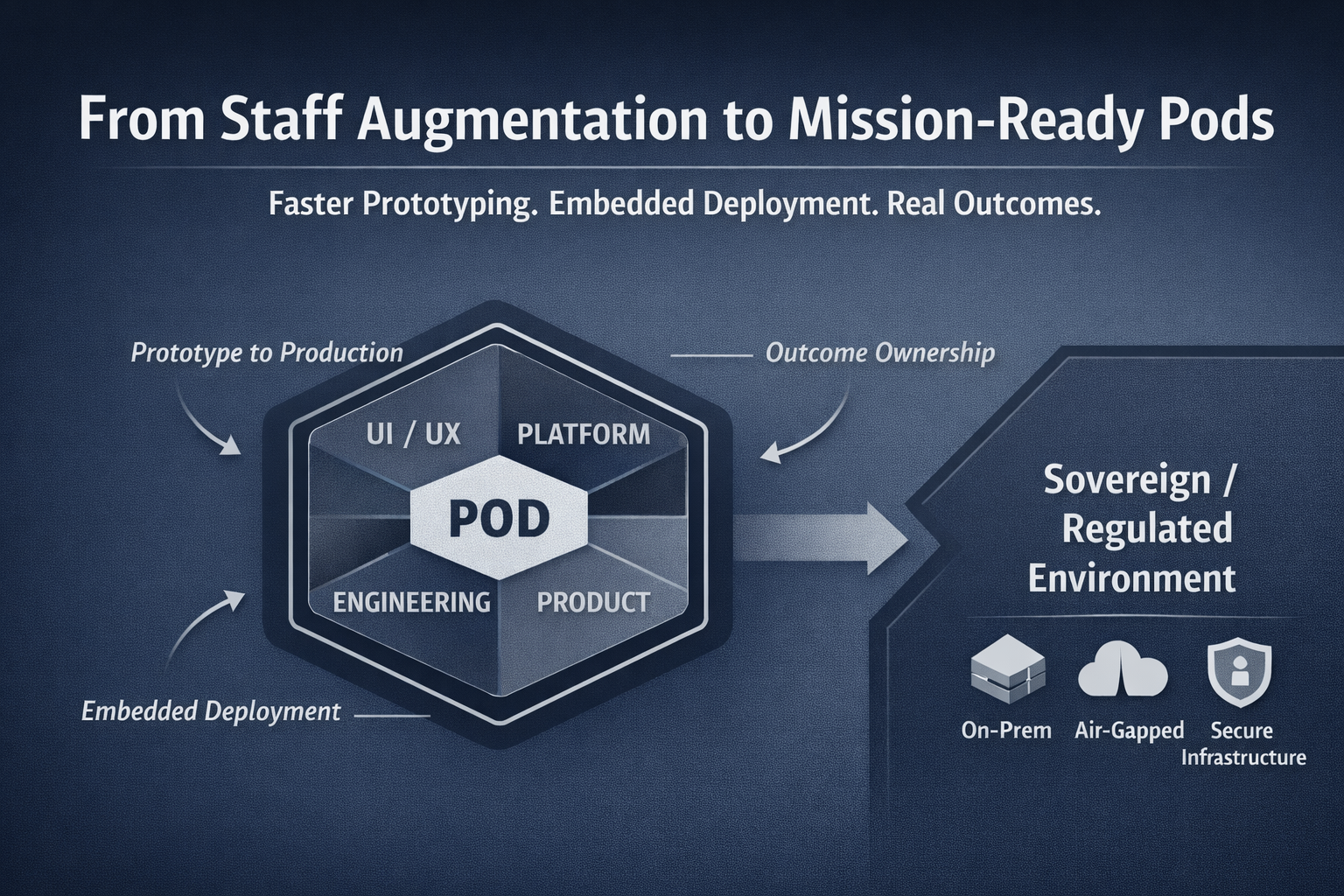
Services Have Changed: From Staff Augmentation to Mission-Ready Pods
For decades, the services industry was optimized around hours, headcount, and utilization. Large teams, long timelines, and fuzzy outcomes were tolerated because enterprise software itself moved slowly. That world is gone.
Today's buyers—especially in regulated, sovereign, and mission-critical environments—are demanding something very different:
- Faster prototyping
- Shorter paths to production
- Teams that own outcomes, not tasks
- Deployment inside real constraints, not idealized clouds
This shift is redefining what a modern services company looks like—and which ones are actually enterprise-ready.
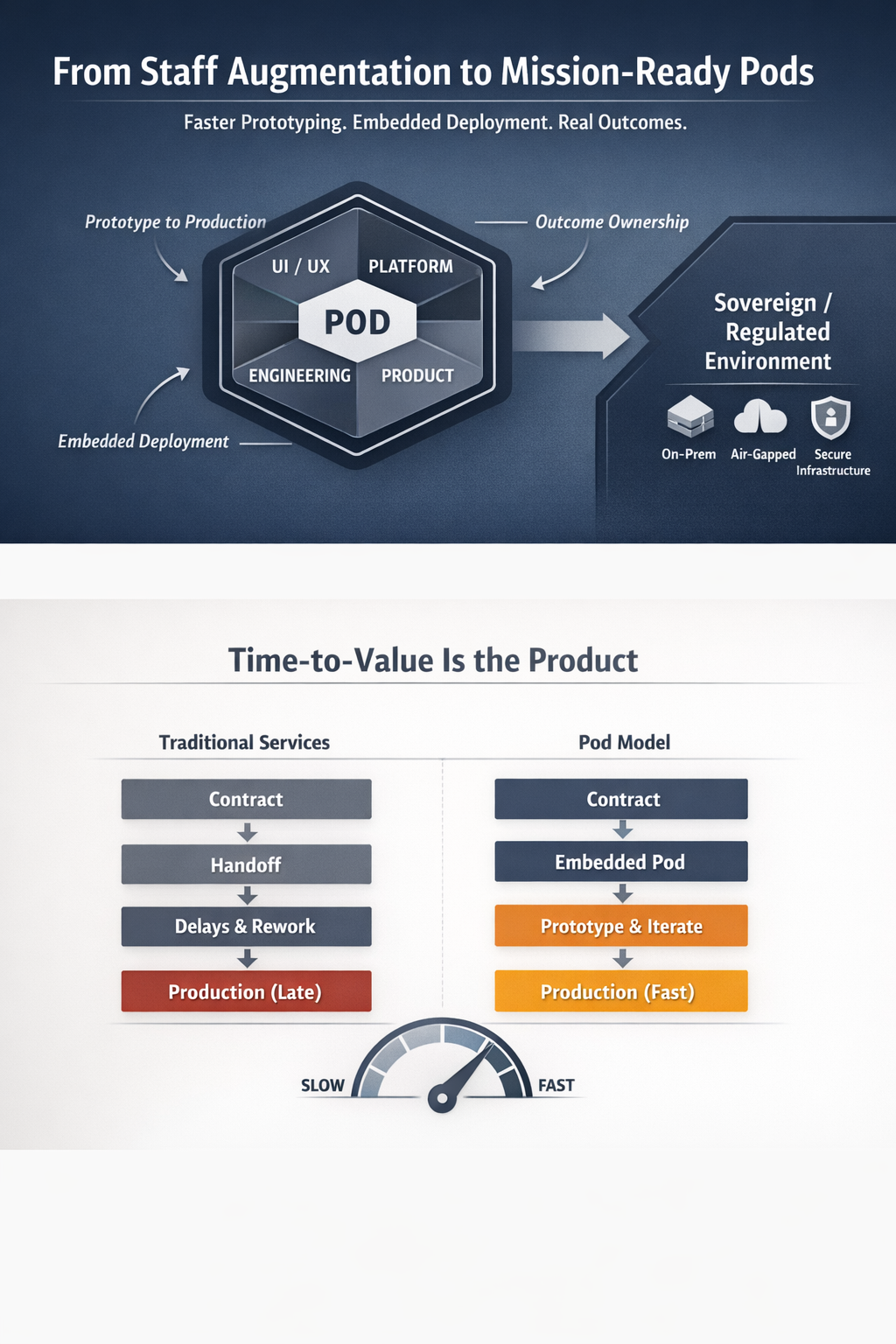
Time-to-Value Is Now the Product
Enterprises no longer struggle to buy software. They struggle to deploy it.
Particularly inside environments shaped by:
- On-prem and air-gapped infrastructure
- Legacy systems and fragmented data
- Regulatory and compliance requirements
- Security-first operating models
According to multiple public sector modernization studies (including those from the U.S. Government Accountability Office and EU digital sovereignty initiatives), most digital transformation failures occur after procurement, not before.
The risk isn't innovation—it's integration drag.
Prototyping Has Become a Strategic Weapon
Modern tooling has collapsed prototyping cycles from quarters into weeks:
- UI/UX prototyping validated directly with end users
- Platform scaffolding that mirrors production constraints
- Iterative workflows validated against real infrastructure
Frameworks like Design Thinking (popularized by IDEO) and Lean Product Development are no longer abstract theory—they are now executable inside hardened environments.
But speed alone isn't enough.
A prototype that only works in a cloud sandbox is theater. A prototype that runs inside a sovereign environment is leverage.
Lessons from Pivotal Labs: Services-Led Software Done Right
Before the current wave of AI transformation, one company demonstrated what services-led software could look like at scale: Pivotal Labs.
I spent formative years at Pivotal, and the lessons from that era are more relevant now than ever.
Pivotal pioneered the idea that services and software aren't separate businesses—they're a flywheel. The model was simple but radical:
- Pair programming wasn't optional—it was how knowledge transferred
- Balanced teams (product, design, engineering) sat together, shipped together
- Client embedding meant working inside customer environments, not shipping code over the wall
- Iteration velocity mattered more than upfront planning
Pivotal didn't just consult. They built Cloud Foundry, trained thousands of enterprise developers, and created a repeatable methodology that VMware eventually acquired for over $2.7 billion.
The lesson? Services that create reusable intellectual property and repeatable delivery patterns are worth more than headcount.
That same philosophy—balanced teams, embedded delivery, outcome ownership—is exactly what the pod model inherits. The difference today is the domain: instead of cloud-native app modernization, we're deploying sovereign AI inside air-gapped environments.
The Pod Model: The New Atomic Unit of Services
Traditional services delivery relies on handoffs—design to engineering, engineering to platform, platform to operations. Each handoff increases latency and failure risk.
The modern alternative is the pod model.
A pod is a self-contained, outcome-oriented team composed of:
| Role | Function |
|---|---|
| UI / UX | Translating real operational workflows into usable systems |
| Platform Engineering | Owning infrastructure, security, and deployment |
| Software Development | Delivering production-grade systems |
| Product Management | Aligning delivery to measurable outcomes |
This mirrors the internal team structures used by high-performing product organizations described in works like Team Topologies—and directly descends from the balanced team model that Pivotal Labs scaled across hundreds of enterprise engagements.
Pods don't augment staff. They own missions.
Why This Model Matters in Sovereign and Regulated Environments
Sovereign and regulated deployments introduce unique challenges:
- SaaS update pipelines don't work in air-gapped systems
- Sensitive data cannot leave national or organizational boundaries
- Hardware constraints vary by site
Organizations deploying sovereign AI systems increasingly rely on on-prem object storage (such as MinIO), localized model fine-tuning, and tightly controlled inference pipelines.
Companies like Palantir have demonstrated the effectiveness of forward-deployed execution, where engineering teams embed directly with customers to operationalize systems in real environments—not idealized ones.
Hardware and Software Must Be Designed Together
Sovereign AI is inseparable from infrastructure.
High-performance deployments often rely on the NVIDIA AI Enterprise stack, including:
- Triton Inference Server for scalable model serving
- TensorRT optimization for reduced latency
- NVIDIA-certified systems for validated performance
Without teams that understand both software architecture and physical infrastructure, enterprises frequently underutilize the hardware they've already paid for.
This hardware-software friction is one of the most common causes of delayed production rollouts in regulated environments.
What Acquirers Look for in Modern Services Organizations
For growth-stage software companies expanding into government, defense, or regulated enterprise markets, services are no longer optional.
But acquirers increasingly differentiate between:
| ❌ Staff Augmentation Firms | ✅ Deployment Accelerators |
|---|---|
| Bill by the hour | Bill by the outcome |
| Handoffs create delays | Pods own delivery end-to-end |
| Generic technical resources | Domain-specific expertise |
| Slow integration cycles | Rapid prototyping and iteration |
High-value services organizations:
- Reduce enterprise sales friction
- Shorten time-to-production
- Enable access to regulated markets
- De-risk sovereign deployments
In M&A terms, this turns services from a margin drag into a strategic asset.
The Future of Services Is Embedded, Fast, and Outcome-Driven
The next generation of services companies won't win by being the biggest.
They'll win by being the ones that can:
- Prototype rapidly inside real constraints
- Deploy where pure SaaS cannot
- Embed seamlessly with customer teams
- Convert contracts into operational systems
At Enfuse, This Is the Model We've Built Around
We don't just design systems. We don't just ship code.
We deliver the last mile—with mission-ready pods built to move fast, deploy securely, and own outcomes where it actually matters.
Ready to see how embedded pods can accelerate your sovereign AI deployment? Learn more about our Forward Deployed Engineering services or reach out to our team.