Build AI-Driven Apps On-Prem: The Sovereign Agent Stack for LLM Orchestration
Build a sovereign app factory with MCP services, Cloudberry data foundation, and model routing that runs on-prem and bursts to Groq. Ship production AI-driven apps while owning your infrastructure.
Build AI-Driven Apps On-Prem: The Sovereign Agent Stack for LLM Orchestration
The "Sovereign Agent" stack: MCP services + Cloudberry data + model routing that runs on-prem (and bursts to Groq)
In our last post, we made a blunt claim:
Infrastructure-only "sovereign AI" is how you end up with empty GPU museums.
That argument was intentionally uncomfortable, because it's true: sovereignty is felt at the service layer—the applications and workflows that touch citizens, customers, and frontline workers.
This post is the practical follow-through.
Because once you accept that sovereignty is earned in services, you hit the next question immediately:
How do you build and ship sovereign services fast enough to matter—without outsourcing your build loop to SaaS?
That's why we built what we call the Sovereign Agent: an on-prem, production-first app factory that orchestrates LLMs, composes MCP services, and deploys on Cloudberry—so you can build production apps while you own your infrastructure.
The real bottleneck is not models. It's manufacturing.
Most orgs approaching "sovereign AI" are optimizing the wrong constraint.
They're optimizing:
- GPU procurement
- data center capacity
- model access
But the constraint that decides whether sovereignty becomes real is simpler:
How many governed, production-grade AI services can you ship per quarter?
Not demos. Not pilots. Services.
Sovereign copilots. Document intelligence. Multimodal assistants. Domain agents. Workflow automation with auditability and redress.
If you can't manufacture those reliably, you don't have a sovereignty strategy—you have a hardware strategy and a hope.
So we built the missing layer: a sovereign app factory.
What we built: a Sovereign Agent composed of sovereign services
Think of the platform as three things working together:
- A Model Gateway (so apps aren't tied to any one model/provider)
- An MCP "menu" of sovereign services (so teams assemble capabilities instead of reinventing them)
- A Cloudberry-powered data foundation (so RAG, embeddings, transcripts, and audit trails are native and scalable)
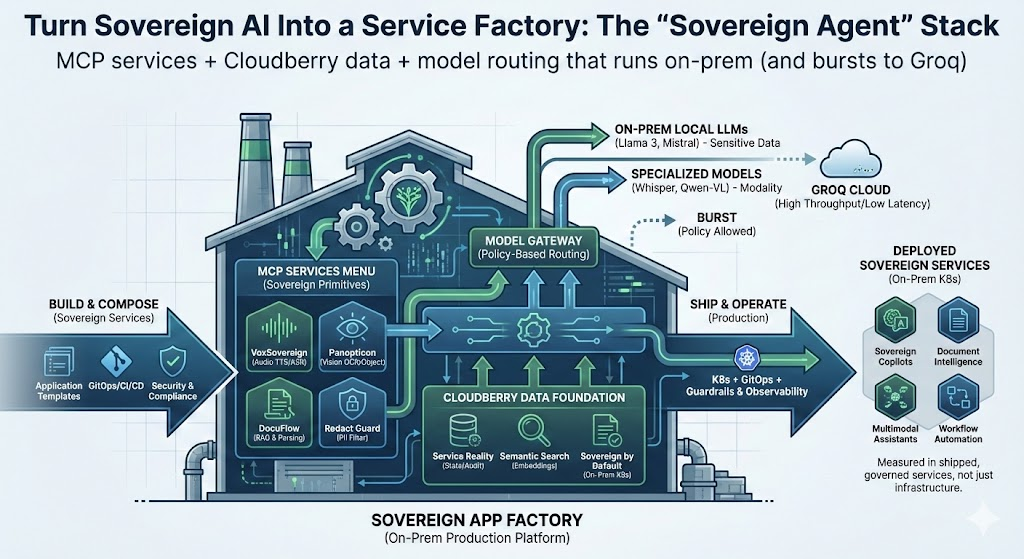
This is the difference between "LLM endpoints" and actual service sovereignty.
1) Model Gateway: one config, any model, full sovereignty
Sovereign services shouldn't be rewritten every time the model landscape shifts.
So the Sovereign Agent uses a Model Gateway that routes requests to:
- frontier cloud models (when policy allows)
- local LLMs like Llama 3 or Mistral (when policy requires)
- specialized models for modality (e.g., Whisper for speech, Qwen-VL for vision)
We also made the gateway OpenAI-compatible, because compatibility is leverage:
- you can reuse existing app patterns
- you can swap backends without rewriting your whole stack
- and you can enforce sovereignty with policy-based routing rather than hard-coded dependencies
This is how you keep sovereignty without freezing innovation.
2) The MCP Menu: sovereign primitives you can compose into real apps
The fastest way to ship sovereign services is to stop building everything from scratch.
That's why we leaned into an MCP architecture: MCP services become the building blocks for production applications—composable, reusable, and governable.
Multimodal sovereignty (that never leaves your infrastructure)
The core idea is simple: audio, vision, and data processing must be sovereign in the same way your structured data must be sovereign.
That's why the platform includes an on-prem "sovereign media suite," including:
VoxSovereign (Audio) Enterprise TTS + transcription locally (voice cloning, meeting transcription, etc.)
Panopticon (Vision) Local computer vision with Qwen-VL for image analysis, object detection, and OCR—without pushing sensitive images/documents out of boundary
DocuFlow (RAG) Parse complex PDFs (including tables and formatting), chunk, vectorize, and query—built for the kinds of documents governments and regulated enterprises actually live inside
These aren't "features." They're sovereign service primitives. Teams can wire them into copilots, workflow systems, portals, and internal tools without re-implementing the hard parts every time.
And for high-stakes environments, primitives like Redact Guard (PII) enforce a critical pattern: the AI doesn't get raw sensitive fields—only what it needs, with immutable audit trails.
3) Why Cloudberry is our data foundation
If sovereign services are the goal, your data layer can't be an afterthought.
We use Cloudberry because the Sovereign Agent needs a data foundation that can do three jobs at once:
A) Store the "service reality," not just analytics
Sovereign services generate and depend on durable state:
- document corpora + metadata
- retrieval traces and citations
- transcripts and media features
- policy tables and workflow state
- audit events for regulators and oversight
Cloudberry is the backbone that makes this state governable and queryable across services.
B) Power semantic search at scale
Modern service sovereignty means embeddings are first-class:
- embeddings for RAG
- embeddings for entity/relationship workflows
- embeddings for transcript/audio search
- embeddings for multimodal indexing
With pgvector as part of the story, Cloudberry becomes a natural home for embeddings alongside the structured data and audit context those embeddings must be accountable to.
C) Stay sovereign by default
Self-hosted, on-prem, deployable on your Kubernetes cluster—no hidden control plane, no "oops your retrieval index lives in someone else's SaaS."
If you want sovereign services, your data foundation has to be sovereign too.
Shipping services means shipping operations: K8s + GitOps + guardrails
A "sovereign app factory" isn't real if it can't survive production.
That's why the platform includes the unglamorous pieces that turn prototypes into services:
- Application templates (React/Next.js frontends, Node/Python APIs, microservices/event-driven scaffolds)
- CI/CD pipelines (multi-stage builds, automated testing gates, rollback automation)
- Security & compliance (SAST/DAST, container scanning, policy-as-code, audit logging)
- Observability stack (tracing, log aggregation, dashboards, SLOs)
- Platform APIs (environment provisioning, secret management, feature flags, A/B testing)
- Self-service environments + golden paths (fast setup, opinionated best practices, inner-source reuse)
And for day-2 operations:
KubeMaster Ops: AI-assisted K8s operations (list pods, fetch logs, restart services) so the platform isn't brittle when reality hits.
This is how you make services repeatable—and sovereignty durable.
Where Groq Cloud fits (and why hybrid is a feature, not a compromise)
Most "sovereign" deployments are not "no cloud ever." They're:
- default private
- selectively hybrid
- always governed
The Sovereign Agent is designed for exactly that.
The pattern: policy-based inference routing
Run the platform on on-prem K8s with Cloudberry as the data substrate.
Then route inference based on policy:
- On-prem local models for sensitive prompts, protected datasets, restricted environments
- Groq Cloud when latency matters, burst capacity is needed, and policy allows the request to leave boundary
Groq becomes the accelerator lane—especially for high-throughput, low-latency experiences—without forcing you to rebuild your apps around a single provider.
Because the Model Gateway is the contract, you can move fast and keep control.
Why this is an on-prem alternative to "prompt-to-app" builders
Lovable/"one prompt = app" tools proved something important: the UX of building software can be radically simpler.
We agree.
But sovereignty changes the requirements:
- the build loop must be inside the boundary
- retrieval, traces, evals, and logs must be sovereign
- identity, governance, approvals, and audit must be native
- deployment must land on your K8s, with your controls
So we built a platform where you can:
- build production apps quickly
- compose sovereign MCP services (vision/audio/RAG/data)
- store and govern service state in Cloudberry
- deploy on-prem or in a sovereign cloud
- optionally burst to Groq when allowed
That's not just "building apps."
That's owning an app factory.
Closing: sovereignty is measured in shipped services
If last post was the warning, this post is the path forward:
Sovereignty isn't measured in GPU counts.
It's measured in:
- how many locally owned, trustworthy AI services are in production
- how quickly you can build the next ten
- and how firmly you control the data, models, and logic they depend on
That's what the Sovereign Agent stack is for.
Build production apps. Own your infrastructure. Orchestrate models, connect MCP services, deploy on Cloudberry—sovereign and on-prem.