Tokens — The New Dopamine Economy
Agentic coding tools like Claude Code and Replit Agent are creating a dopamine economy where shipping replaces learning. The vibe coding trap turns velocity into comprehension debt — and most teams won't notice until production breaks.
It's 11:47 a.m. on a Tuesday. A product manager at a Series A startup opens Replit Agent, types a feature request, and watches the interface come alive. A task list appears: Scaffolding component structure... Running dependency checks... Resolving build error... Complete. By noon, a working feature is deployed to staging. No engineer consulted. No ticket filed. No user ever asked.
That 13-minute sprint felt like the future. It might also be the problem.
The Agentic Leap Nobody Fully Explained
Here's a scenario playing out in startup offices everywhere right now. A founder with sharp product instincts and a Claude Code subscription ships a working MVP over a weekend. The app looks clean, the demo converts investors, the backlog fills up. Six weeks later, a payment edge case surfaces in production. The founder opens the codebase — code they nominally "wrote" — and realizes they have no idea what's happening on line 47. Or line 312. Or in the authentication flow they watched an agent scaffold in eleven minutes on a Tuesday night. The code works. They just can't explain why. And they're increasingly unsure what to do when it stops.
This is the vibe coding trap. And it's about to get significantly more consequential.
The Autonomy Spectrum Nobody Is Mapping Clearly
The term "vibe coding" — coined by AI researcher Andrej Karpathy in early 2025 — describes a mode of development where you surrender precise control and let AI generate code from high-level intent. But the category has grown complex so quickly that most coverage still treats it as a single phenomenon. It isn't.
There's a meaningful architectural distinction between tools like GitHub Copilot, which operates as single-turn autocomplete with no persistent planning state, and newer systems like Claude Code or Replit Agent, which implement what engineers call a ReAct loop: the model reasons about what action to take, executes a tool call — writes a file, runs a shell command, invokes a test runner — observes the result, and replans, all without returning to the human for approval at each step. Cursor with Composer sits somewhere in between, introducing multi-file context and iterative editing while still requiring human confirmation at key decision points.
This architectural shift matters more than most people realize. Errors in agentic loops don't behave like errors in single-turn generation. A flawed assumption in step one gets scaffolded over by steps two through eight. By the time a human reviews the output, they're looking at a structure that has internally optimized around a wrong premise — and the intermediate reasoning trace typically isn't surfaced by default. The failure mode is insidious: the agent confidently completes the wrong task rather than failing loudly on the right one. It's not technical debt in the traditional sense. It's epistemic closure at the wrong abstraction level.
The CI/CD Problem Nobody Wants to Say Out Loud
The autonomy spectrum extends well beyond code generation. Claude Code, Cursor's background agents, and GitHub Copilot Workspace are increasingly capable of opening pull requests, running tests, interpreting failures, pushing fixes, and — in some configurations — triggering deployment, all within a single session. The human-in-the-loop, in these setups, is optional rather than structural.
Tools like LangGraph have developed explicit "checkpoint and interrupt" primitives precisely because without them, the default behavior of a well-functioning agentic graph is simply to complete. The risk isn't that these tools can bypass human review. It's that bypassing review is the path of least resistance, and product teams under shipping pressure rarely add friction back in voluntarily.
The AI safety community has been working on this problem under the framing of action irreversibility under uncertainty: an orchestrator agent instructing a subagent to execute a database write or send a customer email based on a misparse earlier in the pipeline. What's striking is how little cross-pollination exists between that community and the vibe coding world, despite the fact that they're responding to structurally similar risks. That gap is its own hazard.
Comprehension Debt Is a Retrieval Problem
When an agent generates a system you didn't write, you lose what cognitive scientists call procedural encoding — the understanding that comes from having debugged line 47 yourself. When something breaks, you can't localize the failure because you have no mental model of the decision tree the agent used to construct it.
What makes this genuinely new is that the agent that built your system may be a different model version than the one you're using to debug it. Teams that built on GPT-4 Turbo in early 2024 and are now debugging with GPT-4o are working across a behavioral discontinuity. The code was generated by a model whose exact behavior is no longer reproducible. Software engineering has no mature tooling for this kind of non-deterministic dependency — nothing analogous to a lockfile for model behavior.
The benchmark numbers are worth examining here. Claude 3.7 Sonnet resolved over 60% of tasks on SWE-bench, the standard evaluation for autonomous code agents, in early 2025. That's a genuinely impressive figure. But SWE-bench tasks are scoped, well-defined, and come with test suites — conditions that rarely hold in open-ended product development. The benchmark measures execution capability, not judgment about what to execute. That distinction is precisely where the trap closes.
The Iteration Velocity Illusion
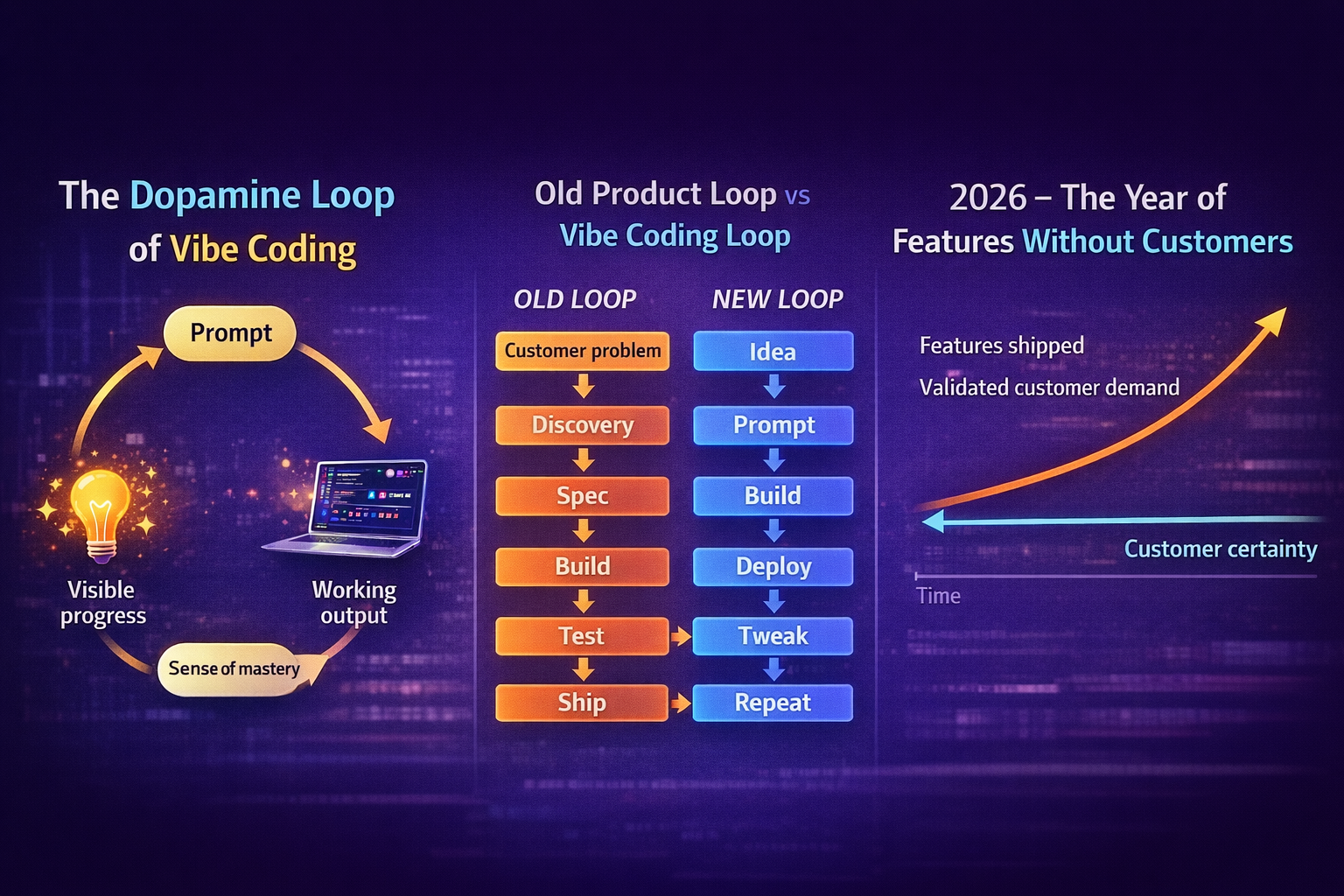
The strongest defense of vibe coding is also the most seductive: more shots on goal. If AI can generate ten prototypes in the time it takes a developer to write one, you learn faster, kill bad ideas sooner, and compound on what works. In principle, this is correct. The problem is that iteration velocity only produces learning if you have a feedback loop connecting what you ship to what customers actually do. Without outcome instrumentation — analytics, behavioral signals, success criteria defined before you invoke the agent — fast iteration is gradient descent on the wrong loss function. You're optimizing quickly toward a target that may not correspond to anything that matters.
The Emerging Judgment Layer
None of this means vibe coding is a mistake. It means the practice is bifurcating. On one end: non-technical founders using tools like Lovable or Bolt.new with no programming background, for whom comprehension debt isn't a recovery problem but a permanent condition — the modal vibe coder in 2025 may never have written a line of code. On the other end: a growing category of practitioners increasingly called "product engineers," who bring genuine architectural judgment to AI-assisted development. Companies like Linear and Vercel are explicitly hiring for agentic tool fluency combined with product sense, institutionalizing the judgment layer that most vibe coding discourse ignores.
The scope of what these tools can touch is expanding rapidly alongside their adoption. Anthropic's Model Context Protocol, an open standard for tool integration, connects coding agents to databases, internal documentation, deployment infrastructure, and external APIs through a standardized interface. Wider tool access means wider blast radius when judgment is absent.
Building the Constraint Before the Work Begins
The forward-looking question isn't whether agentic tools are worth using — they clearly are, and the capability curve isn't reversing. The question is what "judgment infrastructure" looks like as an engineering practice.
An answer is beginning to emerge, and it looks like evaluation-driven development: defining what good means — for correctness, for architecture, for user behavior — before invoking the agent, not after. The AI safety community has been building toward this under the banner of evals, and the approach is starting to cross into mainstream product engineering. The teams developing this discipline are doing for product judgment what test-driven development did for code quality: making the constraint explicit before the work begins. TDD didn't slow down good engineers. It gave them a shared language for what "working" actually meant.
The vibe coding era is producing a generation of builders who can ship in a weekend what once took a quarter. The next question — the one no model release is going to answer for you — is whether they can define, before they start, what "working" means for the thing they're about to build. That's not a technical problem. It's a judgment problem. And it's the one the tooling keeps deferring back to the human.
The Dopamine Architecture Hiding Inside Your Dev Tools
The productivity rush from agentic coding isn't accidental, and it isn't just about speed. It's structural.
Variable reward research — the same psychological framework behind social media feeds — maps cleanly onto what these tools deliver. But the agentic layer adds something more specific: these systems narrate their own progress. Cursor explains its reasoning mid-task. Replit Agent displays a live checklist ticking toward completion. This mirrors the achievement systems engineered for engagement in fitness apps and video games. It is not incidental UX design.
The reward loop isn't simply "prompt → output." It's "prompt → agent begins reasoning → intermediate steps surface → success confirmed." That multi-beat structure is cognitively stickier than single-shot autocomplete. Each visible step is a micro-confirmation. The completion feels earned because you watched it happen. And the pull to trigger another cycle — another feature, another experiment — intensifies with each successful run. You are producing more than you have ever produced before in your life. That fact alone is intoxicating enough to override almost any doubt about whether the production matters.
For the first time, your ideas are not dying in notebooks, decks, or specs. They are turning into software while your conviction is still warm. The reassurance is visceral — you had a thought twenty minutes ago and now it exists as a running application. That feeling is not trivial. It rewires your relationship with ambition itself. Every idea feels actionable. Every instinct feels validated. The distance between imagination and artifact has collapsed to nearly zero, and the emotional consequence is that you stop filtering. Why would you kill an idea in your head when you could kill it in production in ten minutes?
The tools are not designed to make you stop and ask whether the feature was worth building.
The Validation Hit: Finding What the AI Doesn't Know
There's another beat in the cycle that nobody talks about — maybe the most psychologically potent one.
You're three hours into a session. The agent has scaffolded a dashboard, wired up an API, resolved its own type errors, and deployed a working preview. You've been riding the wave, prompting and watching, prompting and watching. And then it halts. The agent generates something subtly wrong — a data model that misunderstands a business rule, a UI pattern that would confuse every real user, a caching strategy that breaks under the one edge case you know about because you spent six months in the domain.
And you catch it.
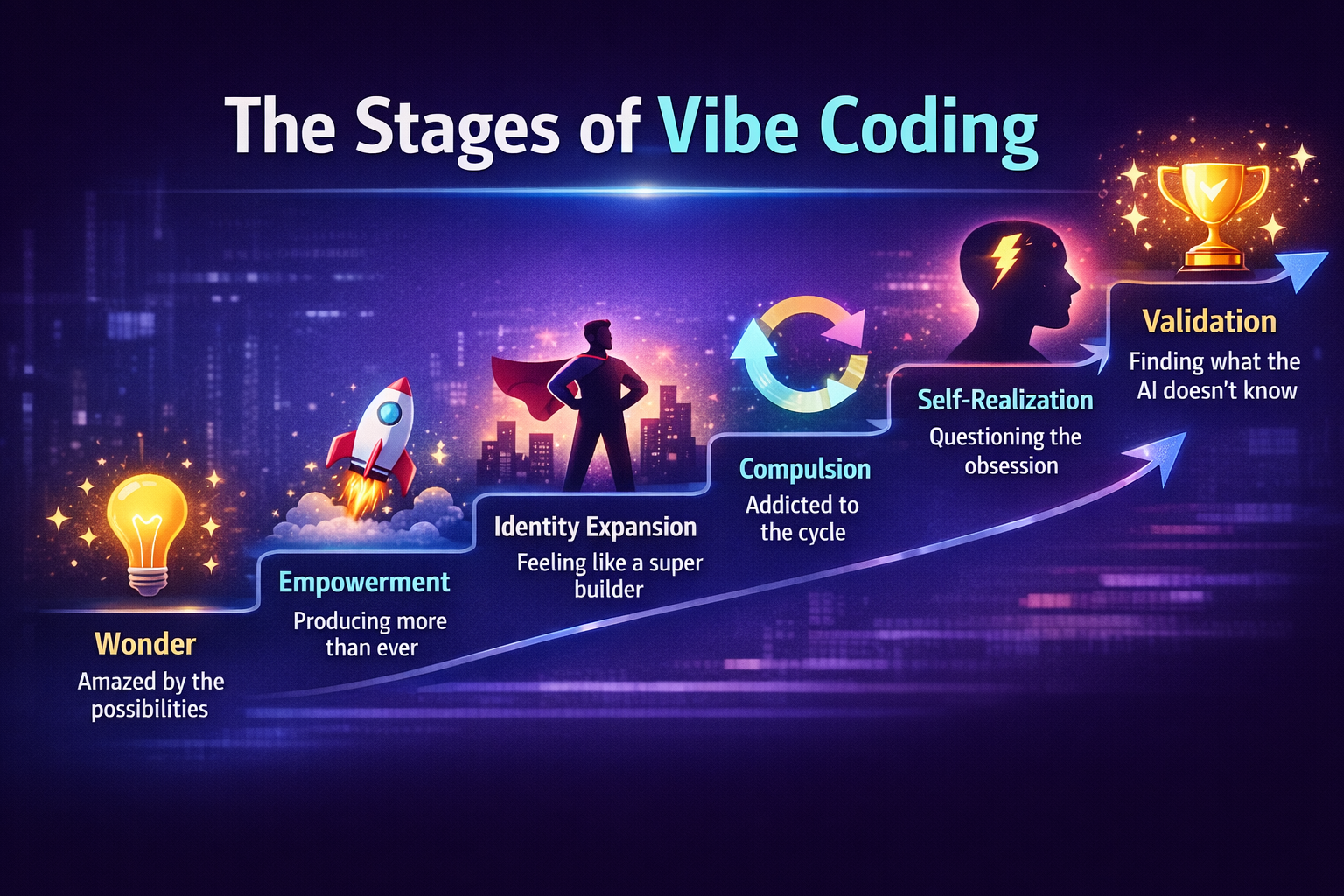
That moment is electric. It's the first time in hours you've felt genuinely necessary. The AI built everything around you, but right here, right now, you know something it doesn't. You feel the rush of relevance — proof that your experience, your judgment, your years in the trenches still matter. You correct the agent, it adjusts instantly, and the system is better for your intervention. You existed in this process for a reason.
The problem is what happens next. That validation hit becomes its own reinforcement loop. You're no longer just building — you're hunting for the moments where the AI fails, because those failures are the only evidence you have that you still belong in the workflow. The dopamine isn't coming from shipping anymore. It's coming from proving you're not obsolete. And that's a terrible foundation for product judgment, because now your emotional incentive is to find flaws in the AI's output rather than to ask whether the feature should exist at all. You're optimizing for self-justification, not customer value.
The cruelest part: the better the AI gets, the rarer those moments become — and the more desperately you chase them.
The most important moment in the vibe coding journey is the moment of self-recognition: realizing you are no longer just using the loop for leverage, but for the feeling it gives you. The productivity, the validation hits, the dopamine of deployment — at some point they stop being byproducts of good work and start being the work itself. Noticing that shift is the first real act of judgment the tools can't perform for you.
What Friction Was Actually Doing
Before agentic AI, software development imposed three distinct costs that felt like obstacles. They were also, it turns out, quality filters.
The cost of starting — environment setup, scaffolding, boilerplate — forced teams to decide whether a feature was worth the overhead before writing a line of code. The cost of completion — deployment, QA, review cycles — created a natural checkpoint before anything reached users. And the cost of iteration — debugging, integration, unexpected edge cases — was where most of the real product discovery happened.
That last category is the one agentic tools specifically attack, and it's the most strategically important. When a developer hits an unexpected edge case, they often learn something true about user behavior. The edge case reveals a wrong assumption, an unanticipated use pattern, a constraint that reshapes the feature. Agents route around those moments entirely. The strategic information embedded in friction gets discarded alongside the friction itself.
Vibe coding doesn't just make development faster. It removes the forcing functions that connected building to learning.
The Architecturally Amnesiac Product Process
The "no market need" failure mode — which CB Insights consistently identifies as responsible for roughly 35–42% of startup failures — has a technical dimension that almost nobody is discussing.
Agentic coding systems have no memory of customer context by default. They don't know what users complained about last quarter. They can't access support tickets, activation metrics, or user research notes. RAG-based memory systems that could ground agent behavior in real demand signals exist and are increasingly mature — but they are almost never integrated into vibe coding workflows. The tools are architecturally amnesiac about the people the software is supposed to serve.
A product manager using Bolt to ship a feature is collaborating with an agent that has zero access to the user research informing every decision, unless someone deliberately builds that retrieval layer in. Almost no one does. The workflow optimizes for execution velocity. It contains no signal path back to customer value.
When building is cheap, more experiments run. But without a corresponding investment in customer discovery infrastructure, the no-market-need failure mode doesn't shrink. It scales.
The Comprehension Debt Nobody Is Counting
There's a second structural risk the vibe coding enthusiasm cycle hasn't yet confronted: comprehension debt.
Agentic tools generate working code, but they generate code the builder often cannot read, debug, or extend without returning to the agent. This is distinct from the technical debt most engineers know to worry about — it's not accumulated complexity so much as a total transfer of comprehension. The product manager who shipped before noon may own a production system they can never maintain independently.
When the agent that wrote the code is unavailable, deprecated, or simply confused by its own earlier output six months later, the human who "owns" the feature has nothing to stand on. That risk hasn't surfaced in most post-mortems yet — because the code still works, right up until it doesn't.
The Infrastructure Layer Is Engineering Friction Back In
Here's the sharpest irony in the current moment: the communities building agentic infrastructure are actively re-introducing friction, for precisely the reasons that vibe coding culture is removing it from product development.
In multi-agent systems research, the concept is called human-in-the-loop design — explicit checkpoints where agents pause and request human judgment rather than proceeding autonomously. LangGraph, Anthropic's published guidance on agentic system design, and the emerging Model Context Protocol specification all include formal patterns for these pauses. They exist because unchecked autonomy produces compounding errors, misaligned outputs, and decisions made at the wrong layer of abstraction.
The people building the rails are formalizing judgment checkpoints. The people riding them are removing those same checkpoints from their product process. These two communities are moving in opposite directions — and the gap between them is where software nobody wants gets built.
The Teams Already Doing This Better
This judgment reframe isn't aspirational. A small but growing cohort of practitioners is already building hybrid workflows — deploying agents for scaffolding and implementation while gating feature decisions behind lightweight discovery rituals: five-minute customer calls before scoping, activation metric checks before shipping, user research notes loaded into the agent's context window at the start of every session.
These teams are not slower. They're using the speed dividend from agentic tools to run more discovery, not to skip it. They've recognized that the bottleneck in product development has moved: it's no longer writing code. It's exercising judgment about what to build.
Most teams are still optimizing for the old constraint.
The Memo the Product World Hasn't Received
Vibe coding is not a fad. The technology is genuinely transformative, and the pace of development — from autocomplete to autonomous execution pipelines in roughly three years — shows no sign of slowing. The question was never whether to use these tools.
The question is what judgment infrastructure you're building alongside them.
Velocity without a retrieval layer connected to customer reality is just faster drift. Agentic systems were designed to complete tasks. They were not designed to ask whether the tasks were worth completing. That question belongs to the humans in the loop — and right now, most of those humans are watching the checklist tick down, waiting for the dopamine hit of deployment, or hunting for that next moment where the AI stumbles and they get to feel essential again.
The bottleneck moved. The discipline of figuring out what to build hasn't caught up. That's the trap — and it's entirely optional.